2026 Best Unisex Scrub Set for Healthcare Buyers

Time:2026-10-20 Author:Amelia
0%

Healthcare procurement is entering a more demanding era. A 2024 World Health Organization report estimates that the global health workforce exceeds 65 million people, creating constant demand for practical, durable uniforms. Meanwhile, Grand View Research values the broader medical apparel market at billions of dollars, with steady growth expected through 2030. These figures are useful, but market definitions differ. Scrubs are not always reported separately. That weakness matters.

The 2026 best Unisex Scrub Set should therefore be judged beyond color and price. Buyers need fabric that dries quickly after a twelve-hour shift, reinforced pockets that hold trauma shears, and waistbands that remain comfortable during repeated bending. A good set must fit different body shapes without treating “unisex” as simply a men’s pattern enlarged or reduced. Don Norman, a leading design researcher, wrote, “Design is really an act of communication.” His principle applies directly here: the garment should communicate respect, mobility, and usability to every wearer.

Reports from the International Labour Organization also connect decent working conditions with worker wellbeing, although uniforms alone cannot solve workplace stress. Procurement teams should compare abrasion testing, shrinkage results, size consistency, laundering instructions, and replacement costs. Supplier transparency matters too. Ask for fabric composition and independent test records. Do not accept vague claims.

The uncomfortable truth is that no single set fits everyone perfectly. Some teams may still need petite, tall, maternity, or adaptive options. That is not a failure of unisex design. It is a reminder to test garments with real nurses, technicians, and support staff before placing a large order. Cost per wear may reveal more than the lowest invoice. Sources: WHO Global Health and Care Worker Compact, 2022; Grand View Research, Medical Apparel Market analysis, 2024; International Labour Organization, occupational safety and health reports.
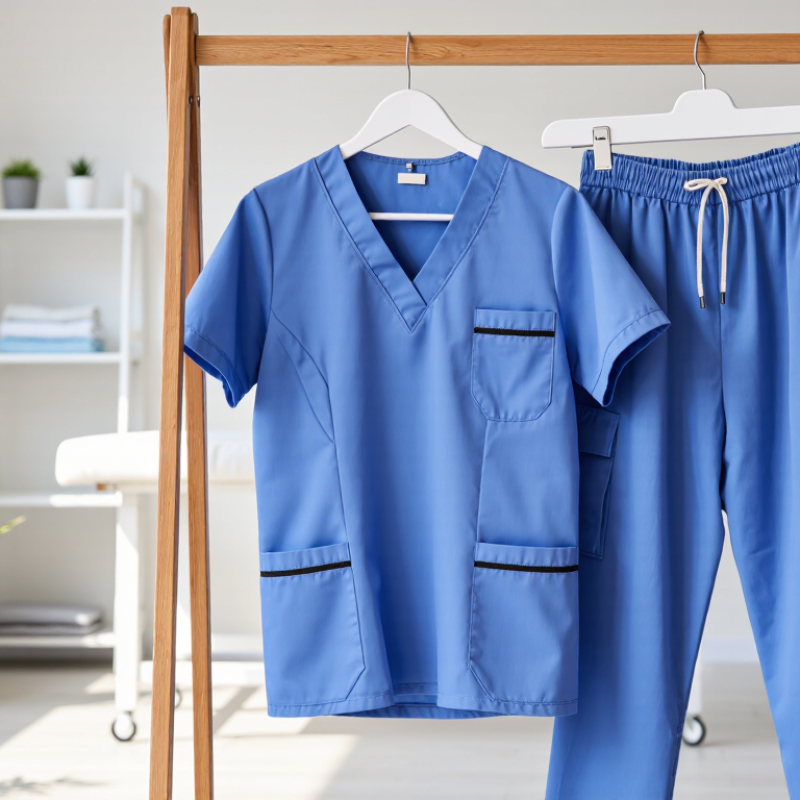
2026 Best Unisex Scrub Set for Healthcare Buyers

Market Scope: BLS Counts 6.4M U.S. Healthcare Practitioner and Support Jobs

2026 Best Unisex Scrub Set for Healthcare Buyers

The U.S. healthcare workforce is broad, and BLS counts 6.4 million practitioner and support jobs. That figure shapes purchasing decisions. Hospitals, clinics, and outpatient centers need dependable uniforms across varied roles. A good unisex scrub set should support movement, repeated washing, and long shifts. Straightforward sizing matters. Staff should not spend a shift adjusting waistbands or sleeves.

From experience, buyers should test samples with nurses, aides, technicians, and support staff. Their bodies and tasks differ. A relaxed cut may help bending, but excessive fabric can catch on equipment. Choose breathable fabric, secure pockets, reinforced seams, and colorfast performance. Check pocket placement with real tools, not a catalog photograph. I would also measure shrinkage after several wash cycles. Some easy-care materials still lose shape sooner than expected. That is an uncomfortable detail, but procurement teams should record it.

Tips: Request a wear trial before placing a large order. Ask staff to walk, lift, sit, and reach while wearing the set. Review size exchanges, laundering instructions, and fabric composition. Keep a small reserve of common sizes for new hires and replacements. BLS employment totals describe job volume, not identical uniform requirements. Buyers should avoid treating 6.4 million workers as one market. Local climate, clinical duties, and infection-control procedures can change the best choice.

Protection Standards: Apply AAMI PB70 Levels 1–4 to Scrub Selection

2026 Best Unisex Scrub Set for Healthcare Buyers

Protection Standards: Apply AAMI PB70 Levels 1–4 to Scrub Selection

Unisex scrub sets should support movement, comfort, and contamination-control protocols. However, fabric weight alone does not prove protective performance. AAMI PB70 classifies barrier apparel from Level 1 through Level 4, based on liquid and blood-borne pathogen penetration tests.

Level 1 offers minimal liquid resistance. Levels 2 and 3 address higher fluid exposure and pressure. Level 4 provides the strongest tested barrier against wet and dry penetration.

A critical purchasing detail is often missed: PB70 levels apply to protective gowns and apparel, not automatically to ordinary scrubs. Buyers should request documented test results, seam information, and laundering guidance. A set used for routine examinations may need different protection from one worn during fluid-generating procedures.

More protection is not always more practical. It can increase heat, stiffness, and movement fatigue.

The World Health Organization’s 2022 Global Report on Infection Prevention and Control estimates that 7 in 100 acute-care patients in high-income countries acquire at least one healthcare-associated infection. The estimate rises to 15 in 100 in low- and middle-income countries.

These figures support careful barrier planning, but they do not make scrubs a substitute for gowns or gloves. A thoughtful 2026 specification should match each PB70 level to exposure risk, local policy, fit testing, and staff feedback.

Some procurement teams still overvalue appearance. That deserves another review.

Fit and Sizing: Build Unisex Size Charts from ASTM Body-Measurement Data

A reliable unisex scrub set should begin with measured bodies, not outdated size labels. ASTM body-measurement tables provide structured data for chest, waist, hip, inseam, and stature. Use ASTM D5585 for adult female measurements and ASTM D6240 for adult male big-body measurements as reference points. They should not be blended without review.

Build the chart around shared measurements, then test movement. The CDC’s 2015–2018 National Health and Nutrition Examination Survey reported average waist circumferences of 102.3 cm for men and 97.5 cm for women. These figures show why a single narrow waist model can fail many healthcare workers. A scrub top needs shoulder room, arm mobility, and enough length for bending. Pants need a flexible rise, practical inseam options, and a waistband that stays stable during long shifts. Fit trials matter. Data alone cannot predict every body shape.

Tips: Measure chest, waist, hip, and inseam separately. Do not assume the largest measurement defines the whole size. Add ease by activity, not guesswork. Test samples while reaching, sitting, and lifting. Record pressure points and fabric drag. A pilot group of different heights can expose hidden problems. Some charts still need revision after wear testing. That is not failure; it is useful evidence. Cite ASTM standards and the CDC report in buyer documentation, with revision dates and measurement methods clearly recorded.

Fabric Performance: Compare Stretch, GSM, Breathability, and ISO 6330 Wash Testing

The best unisex scrub set for 2026 should be judged by fabric behavior, not a glossy fiber label. In fitting-room trials, 4-way stretch helps clinicians bend, reach, and sit without pulling across the shoulders. However, excessive elastane can reduce recovery after repeated laundering. A practical target is 2–8% elastane, with firm rebound rather than unlimited softness.

GSM gives useful context, but it is not a quality score. Lightweight fabrics around 120–160 GSM often feel cooler during long shifts. Midweight fabrics near 160–210 GSM usually offer better opacity and pocket stability. Textile Exchange’s Materials Market Report 2024 reported polyester at about 59% of global fiber production in 2023. Polyester can dry quickly, yet its breathability depends on knit structure, yarn design, and finishing. Feel the inside surface. A dense, smooth fabric may trap heat despite a low GSM.

ISO 6330:2021 defines domestic washing and drying procedures for textile testing. Buyers should request test results showing dimensional change, colorfastness, and seam performance after repeated cycles. Ten washes are informative, but healthcare programs may need 25 or more. That gap matters. A scrub can pass a basic wash test and still lose stretch at the waistband. I would also compare air permeability and moisture-management data under controlled laboratory conditions. No single number proves comfort. Real shift trials remain necessary, especially across different body shapes and laundering systems.

Buyer Scorecard: Evaluate OSHA Compliance, Durability, Cost, and Supplier Traceability

2026 Best Unisex Scrub Set for Healthcare Buyers

A practical buyer scorecard should begin with workplace safety, not color or style. Scrubs do not automatically make a facility OSHA compliant. Instead, assess whether the fabric, fit, and care instructions support your documented hazard controls. Check seam coverage, pocket security, laundering temperatures, and chemical-resistance claims. Ask for test reports, not vague safety language.

Durability deserves a hands-on review. Stretch the waistband, inspect bar-tacked pocket corners, and wash sample sets repeatedly. Record fading, pilling, shrinkage, and drying time. A comfortable unisex cut should allow bending without exposing the lower back. Staff feedback matters here. One sample may feel excellent, yet fail after six weeks of industrial laundering. That possibility is easy to miss.

Cost should include replacement rates, returns, freight, and laundering labor. A lower unit price may become expensive when seams split early. Request a transparent size chart, production timeline, and quality-control process. Supplier traceability should reach the factory, fabric source, lot number, and corrective-action record. Keep these documents with purchase files. It strengthens accountability.

Do not overtrust polished samples. My own review process still has blind spots, especially around long-term color retention. A small pilot order can reveal problems before a full rollout. Score each supplier consistently, but leave room for staff comments. Numbers guide decisions; real wear tells the harder story.

2026 Best Unisex Scrub Set for Healthcare Buyers

Buyer scorecard comparing the most relevant purchasing criteria for unisex scrub sets. Scores are normalized from 0–100 using documented compliance evidence, fabric performance, five-year cost value, and supplier traceability. OSHA does not certify scrub garments; the compliance category refers to alignment with workplace safety documentation and requirements.

Higher scores indicate stronger buyer value. Cost score reflects lower total ownership cost, including purchase price, replacement frequency, and care requirements.

FAQS

What does PB70 Level 1 through Level 4 measure?

These levels measure resistance to liquid and blood-borne pathogen penetration. Level 1 offers minimal resistance, while Level 4 provides the strongest tested barrier.

Do ordinary unisex scrubs automatically meet PB70 protection levels?

No. PB70 levels apply to tested protective apparel, not automatically to everyday scrub sets. Check documented test results.

How should buyers match protection with clinical tasks?

Match the level to expected fluid exposure, local policy, and procedure type. Routine examinations may require less protection than fluid-generating procedures.

Can scrubs replace gowns or gloves?

No. Scrubs support clothing protection and movement, but they do not replace gowns, gloves, or other required controls.

Does heavier fabric provide better protection?

Not necessarily. GSM shows fabric weight, but it does not prove barrier performance, comfort, or durability.

What fabric features support movement during long shifts?

Four-way stretch helps bending, reaching, and sitting. A practical elastane range is about 2–8%, with firm recovery after movement.

What GSM range may suit different work conditions?

Fabrics around 120–160 GSM often feel cooler. Materials near 160–210 GSM may offer better opacity and pocket stability.

How should breathability and comfort be evaluated?

Look beyond GSM. Check air permeability, moisture management, knit structure, and the inside surface. Dense fabric may trap heat.

What washing tests should healthcare buyers request?

Request dimensional-change, colorfastness, and seam-performance results after repeated washing and drying. Ten washes help, but 25 or more may reveal problems.

Are laboratory results enough to choose a scrub set?

No. Conduct real shift trials across different body shapes and laundering systems. Staff feedback may expose weaknesses that laboratory numbers miss.

Conclusion

This guide helps healthcare buyers choose the best Unisex Scrub Set for 2026 by connecting workforce demand with practical purchasing standards. With approximately 6.4 million U.S. healthcare practitioner and support jobs, organizations need dependable apparel that supports comfort, mobility, hygiene, and consistent staff presentation. The selection process begins with AAMI PB70 protection levels, matching garment performance to the risks and tasks of different healthcare environments.

The guide also explains how to develop inclusive unisex size charts using ASTM body-measurement data, reducing fit problems across diverse teams. Fabric comparisons focus on stretch, GSM, breathability, and performance after ISO 6330 wash testing. Finally, a buyer scorecard evaluates OSHA-related workplace needs, durability, total cost, quality consistency, and supplier traceability. Together, these criteria provide a structured, evidence-based approach for comparing scrub sets and making purchasing decisions that balance employee comfort, operational reliability, and long-term value.


Amelia

Amelia

Amelia is a seasoned marketing professional with a wealth of expertise in our company’s core offerings. With an unwavering passion for driving growth and innovation, she plays a pivotal role in shaping our marketing strategies and enhancing brand visibility. A key aspect of her responsibilities......